
"The future is already here; it's just not very evenly distributed." The line is credited to William Gibson, the science fiction writer who coined the word cyberspace.
I believe the same is now true of AGI (Artificial General Intelligence). It's already here for some people, in some kinds of work. I'm one of them, and the work is software development.
Mental exoskeletons
Six months ago, in May 2026, I started building software again as a hobby, with Claude Code at my side. My test case was the Rethink Culture app (opens in a new tab). The app measures company culture: employees anonymously score 21 dimensions of their working life, built on Maslow's hierarchy of needs, and leaders score the culture systems they have put in place, from psychological safety to performance management. A developer and a designer had spent 6 months building it on Bubble, a no-code platform.
Working part-time, Claude Code and I rebuilt the whole thing in a month. That month included dusting off my skills as a retired professional developer and learning how to work with an AI collaborator — building new skills, guardrails and learning to love black terminal windows. Along the way, we improved and fixed a lot, including a piece of database logic the original builders had got wrong.
Over the next 2 months, again part-time, we tripled the app's features. Features that had sat in my "wish I could build this one day" pile for years, because I could never justify the developer cost, finally shipped.
The early weeks were bumpy. Claude would build things I hadn't asked for, and we went back and forth a lot. So I lovingly fenced it in with guardrails: a strict database schema, unit tests, browser tests, logic tests, planning skills and pre-push agents. I built peace of mind.
The rhythm felt familiar. It was like managing an outsourced developer and designer: I set the vision, supervised the work and checked the test cases. Over the next few months, we both learned to collaborate better, learning to deal with each other’s idiosyncrasies and perfect imperfections.
Today my Claude Code developer is smarter and more capable than the human who first built the app, at roughly a hundredth of the cost (5 months of Claude max subscription vs 50K EUR in development costs). It listens. It never tires. It has automated all the QA and requires far less oversight. I nudge it with hundreds of small UX tweaks, and it nudges back with blind spots I'd missed and edge cases only a perfectionist would lose sleep over.
Claude Code, running Opus 5.5 as I write this, has become my mental exoskeleton: a technology I wear that gives me superhuman powers. For this job, it does what I'd expect of AGI. It beats a capable human professional on both speed and quality, with less amount of oversight needed. Granted, AGI implies breadth of intelligence across tasks beyond coding, but as I will argue next, this depends not on the AI model, but on the training set.
Unevenly distributed
So, is every developer now superhuman? Tracking how software development changes in the AI era is what we do at SlashData, the company I founded and lead. The short answer is no.
AI itself is everywhere: according to SlashData, 88% of professional developers use it in some form. Yet fewer than half (42%, up from 30% two years ago) have AI inside their code editor, where it can read the codebase and make changes itself. Even those keep their agents on a short leash. In SlashData's Q3 2026 AI developer tools benchmark, only 7% of professional AI developer tool users said nothing limits how much freedom they give an agent. The rest worry about agents touching secrets (40%), making more changes than anyone can review (36%), or running up costs they can't predict (34%).
The type of project matters too. I rebuilt an app I own, end to end, on a clean slate. Most professional developers work on production code with years of history and a web of back-end dependencies, where the gains can be smaller or harder to realise.
Other researchers agree. When METR asked 16 experienced open-source developers (opens in a new tab) to fix real issues in their own mature projects using early-2025 AI tools, "they take 19% longer to complete issues". The developers themselves believed AI had made them about 20% faster. A 2026 follow-up (opens in a new tab) with 57 developers and newer tools pointed to a small speed-up instead, of 4% to 18%, though METR itself treats that result as weak evidence, partly because many developers now refuse to work without AI. Stanford's Yegor Denisov-Blanch, studying over 100,000 developers (opens in a new tab), puts the gain on complex work in existing codebases at 0 to 10%.
Software development provides a playground for where superhuman powers are heading. Today, those powers reach some people, in some kinds of work. Part of the explanation may lie in how AI models are trained.
Fast and slow
Most of what we do runs on autopilot: walking, catching a ball, reading a face, knowing a vase will shatter if it falls. Evolution and a lifetime in a body trained that into us. On top, sits a thin layer of conscious thought, the few things we can hold in mind and reason about right now.
Daniel Kahneman named these 2 modes in Thinking, Fast and Slow (2011). System 1 is fast and automatic: the unconscious at work. System 2 is slow and deliberate: the conscious mind, with its tiny working memory.
AI models, I'd argue, have the same metaphorical split:
-
Training is the model's unconscious, its System 1: patterns baked into its weights, available instantly, without reasoning.
-
Context is the model's conscious mind, its System 2: the tokens in front of it right now, which it can read, compare and reason over.
Dario Amodei, Anthropic's CEO, sees something similar. "Pre-training is not like the process of humans learning, but it's somewhere between the process of humans learning and the process of human evolution," he told Dwarkesh Patel in February 2026 (opens in a new tab). Learning inside the context window, he added, is "something between long-term human learning and short-term human learning".
That gives us two axes on which to compare humans and machines: how much each has been trained on, and how much each can hold in mind at once.
Into the AI subconscious
AI models are deeply trained on a narrow slice of human experience. Training started with books and grew to swallow most of the public web, unsavoury corners included. Frontier labs then paid thousands of low-wage workers, many in developing countries, to label the worst of that material and rate model answers, a story Karen Hao recounts in Empire of AI (2025).
Measured in words, that is far more than any human ever reads. Amodei puts a human at hundreds of millions of words by age 18 (opens in a new tab), against hundreds of billions to trillions for models. At the RAISE Summit in Paris in July 2026, Yann LeCun, Meta's former chief AI scientist, put all the text on the internet at roughly 100 terabytes, or around 400,000 years of reading for one person.
But humans learn through all their senses, not language alone. By LeCun's maths (opens in a new tab), a 4-year-old has taken in about the same 100 terabytes through vision alone. Add sound, touch, smell, taste and years of moving a body through the physical world, and the human training set dwarfs the machine's.
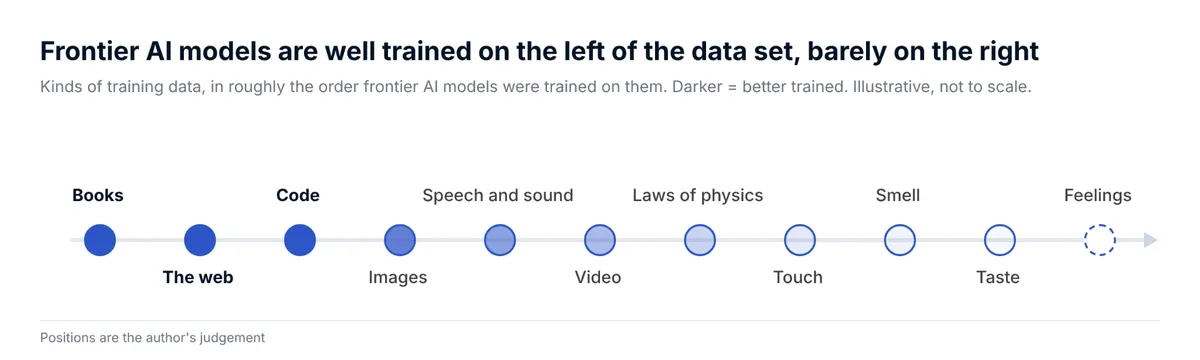 Training depth by domain · positions are the author's judgement, not to scale
The evolution of training frontier AI models runs from books, the web and code, where models have seen more than any human ever will, out to the physical world, where they have seen very little. At the far end sit our feelings, from hunger and pain to emotion, a data set no sensor has ever fully recorded. This is a core reason why AGI is so unevenly distributed today. Even the forecasters most bullish on AI (opens in a new tab) now describe it as "jagged": "superhuman at AI research but still weaker than humans at many other things". The best model at the time of writing, Claude Fable 5.2, now completes 41.3% of real freelance projects well enough for a client to accept them, according to the Remote Labor Index (opens in a new tab).
Roboticists have a name for this: Moravec's paradox (opens in a new tab). In 1988, Hans Moravec observed that "it is comparatively easy to make computers exhibit adult-level performance on intelligence tests or playing checkers, and difficult or impossible to give them the skills of a one-year-old when it comes to perception and mobility".
The AI conscious mind
Let’s consider a second axis: the context window, or the amount of information a frontier AI model can process at the same time.
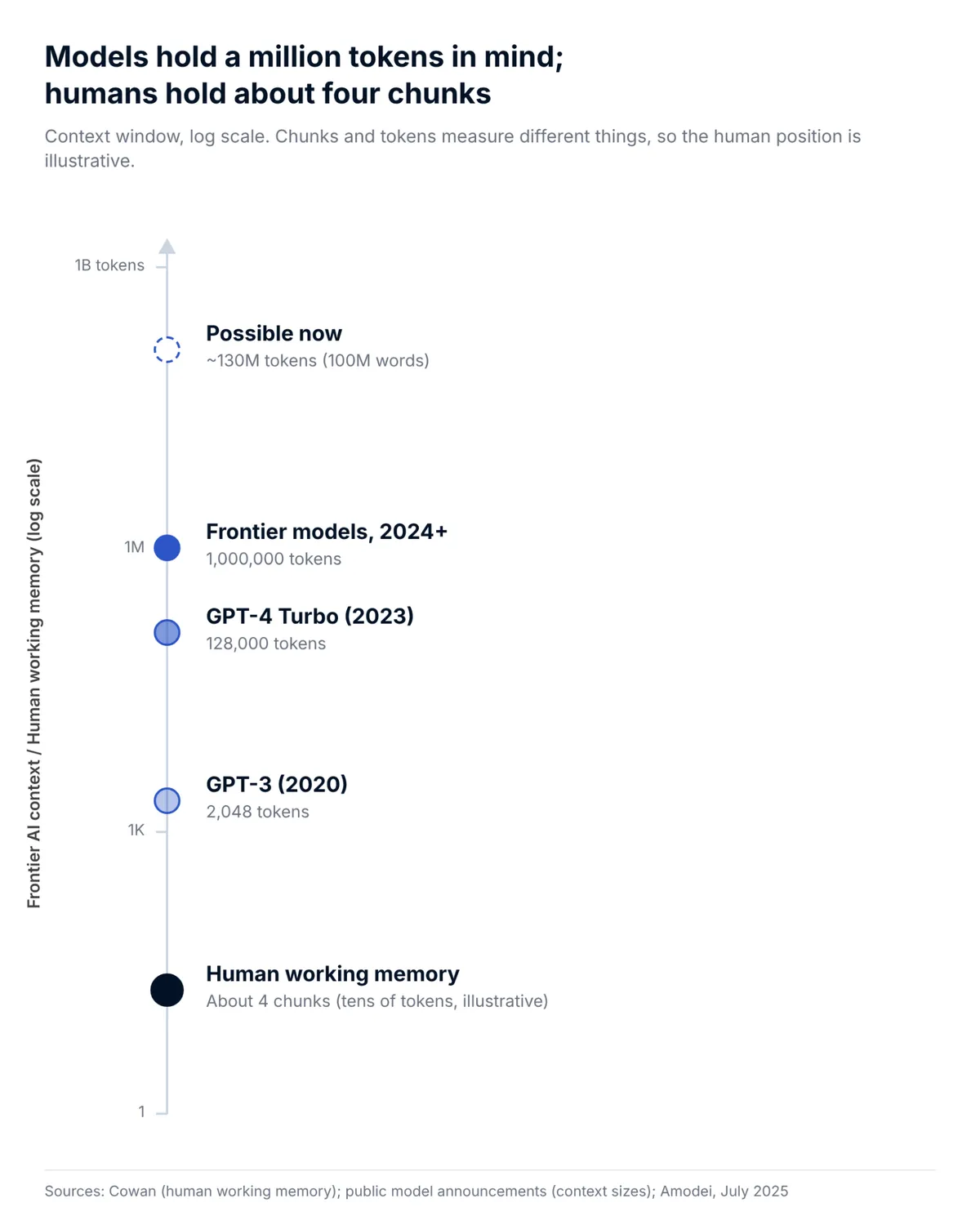
Models went from about 2,000 tokens of context with GPT-3 in 2020 to 128,000 with GPT-4 Turbo in 2023 (opens in a new tab). A million tokens, first offered by Google's Gemini 1.5 Pro in 2024, is now the norm, with Anthropic's Claude Opus 5 (July 2026) and OpenAI's GPT-5.6 Sol in Codex (August 2026), and even open models such as Moonshot AI's Kimi K3 (opens in a new tab) (July 2026).
In July 2025, Amodei went further (opens in a new tab): "there's no reason we can't make the context length 100 million words today, right? Which is roughly what a human hears in their lifetime." What holds it back, he said, is the computing power to run it: "It's really inference support".
And humans? How much information can we hold in our working memory at the same time? Psychologist Nelson Cowan's research (opens in a new tab) puts human working memory at about 4 chunks at a time; George Miller's older estimate was 5 to 9.
But what is a “chunk”? It’s any unit that your memory treats as a single item: a letter, a number, or even a familiar phrase. It depends on the material and the person. Asked to repeat a list of unrelated words, people manage about 5. When the words form a sentence, that rises to around 15 (opens in a new tab).
Chunks and tokens measure different things, so there is no exact conversion. But at roughly 1.3 LLM tokens per word, the order of magnitude is tens of tokens, against a model's million.
This explains my daily frustration with my otherwise loyal Claude. It hands me pages explaining its train of thought, as if I had a million tokens to spare. I can hold about 4 chunks in mind; Claude holds a million tokens per conversation. On this axis, I am the bottleneck. I'm not alone. At Web Summit this month, Glean's Arvind Jain argued that AI output meant for a human should be capped at a page, and Manus AI's Tao Zhang described engineers starting the week with more than 200 decisions waiting for them.
Plotting the frontier
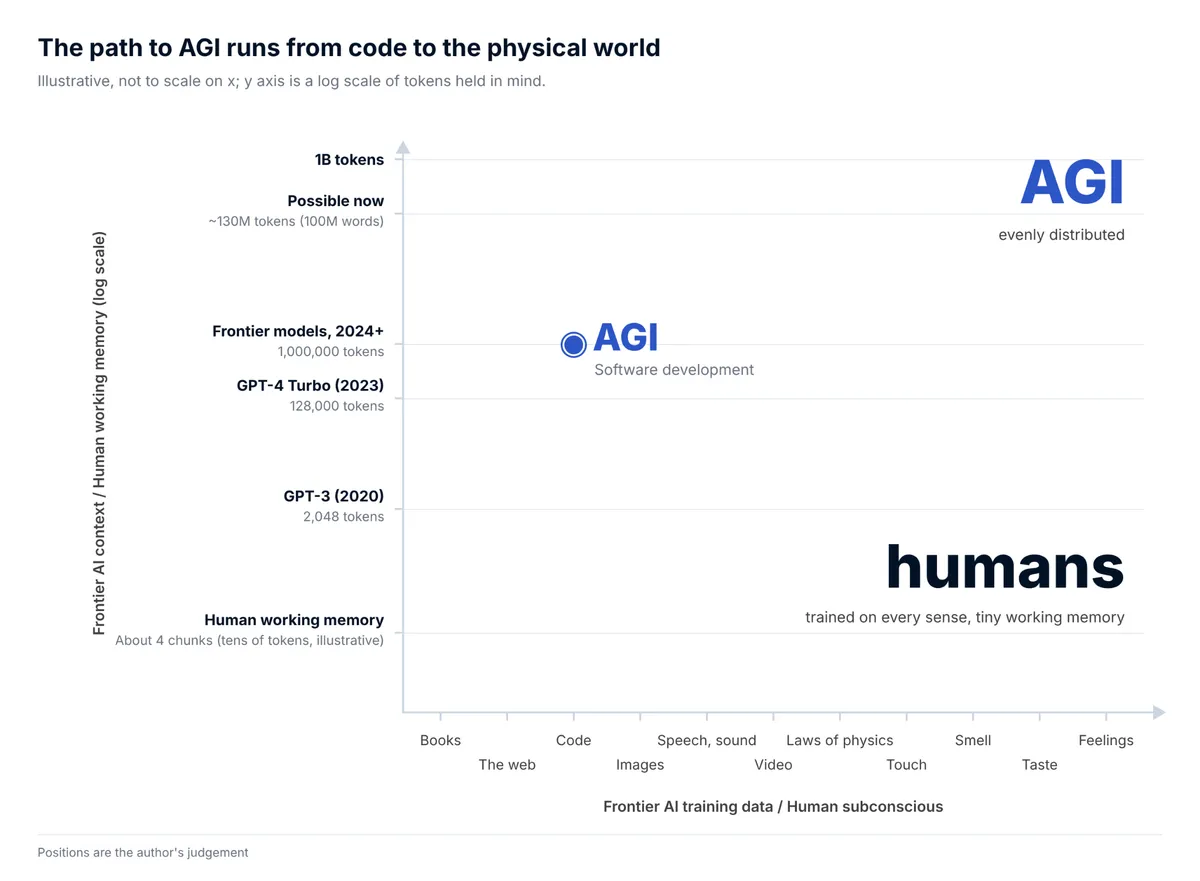
Let’s put the two axes together. Put the training data set on the horizontal axis, from left (books, web and code) to right (the physical world and senses). Put context on the vertical axis, from human working memory up to a billion tokens.
Humans sit bottom right: trained on every sense, holding about 4 things in mind. AGI sits top right, with vast context and a wide data set. Today's models already have the context. What holds them back is the breadth of their training.
Where a job needs only the left-hand end of the chart, as software does, models have already reached AGI-like capability. I see it every day in Claude Code. Everywhere else, the data set has to widen first. That is why frontier labs are buying second-hand books by the million to scan and then destroy (opens in a new tab) for competitive advantage, and approaching companies, both thriving and defunct, with hard cash (opens in a new tab) for access to the emails, chats and operational data (opens in a new tab) they have amassed.
First come, first served
Put the 2 axes together and Gibson's unevenly distributed line explains itself in full technicolour. AI context is the even part: frontier models all get a similarly vast context window, whatever the job. Training is the uneven part. Training methods, tools and feedback all play a part, yet a model rarely excels at a job it has seen little data for.
Over the next few months and years, I expect we'll see AGI arriving domain by domain. My hypothesis is that it will broadly follow the order in which we've fed models data from our human experience, with investment, economics and deployment constraints reshuffling the timeline. The forecasters behind the AI 2027 scenario (opens in a new tab) now give a 35-65% chance that AI can automate all white-collar work before 2028. Right now it has reached the left hand side of the chart, and that's why some of us already work with AGI every day while most people have yet to meet it.
Software development went first, for three reasons I can see. First, code is the most written-down skill there is. Developers have spent decades publishing their work in the open on GitHub and explaining it to each other on Stack Overflow.
Second, code is checkable. Run it and you know whether it works, which gives frontier labs a cheap, endless signal to train against. Andrej Karpathy, a founding member of OpenAI, puts it neatly (opens in a new tab): "Software 1.0 easily automates what you can specify. Software 2.0 easily automates what you can verify".
Third, it also helps that the frontier labs are in a winner-takes-all race to reach AGI first, and the latest frontier is models that build their own software code. Anthropic's IPO filing from October 2026 (opens in a new tab) states that "over 90% of the contributions to our codebase in September 2026 were written by Claude", and puts it plainly: "Within months of its release, autonomous coding became the reference point for measuring the progress of frontier AI". METR, an independent AI evaluator, estimates (opens in a new tab) that Anthropic is now making AI progress about twice as fast as its historical rate, mostly thanks to its own AI. Frontier labs have built their models for their own job first.
If AGI is unevenly distributed, so are its gains. Developers and software companies are capturing them first. As Sequoia's Julien Bek guestimated in March 2026 (opens in a new tab): "Software engineering accounts for over half of all AI tool usage across professions. Every other category is still in single digits".
Anthropic's own numbers point the same way. In its September 2025 Economic Index (opens in a new tab), computer and mathematical tasks, including coding, was the single biggest use of Claude, at 36% of conversations, and most of the top workloads on its API were coding tasks. Even inside software teams, the gains are hard to pin down: 88% of engineering leaders surveyed by SlashData say their organisation measures AI's impact, yet only 39% of those do it formally.
Stanford economist Erik Brynjolfsson and his co-authors (opens in a new tab) find that early-career workers in the most AI-exposed jobs now sit 19% below where they would be had they kept pace with less exposed peers, while older workers have held up. SlashData's data shows a similar disparity: 62% of developers with 16+ years of experience say AI saves them time on repetitive work, against 42% of those in their first 2 years.
Everyone else follows as models' training widens to reach their domain. To see who's next, watch where training data is being collected. Perhaps robotics is the next frontier, giving models touch, balance, and movement that humans already experience and learn from, since birth. The race to teach machines the rest of our senses has started. Osmo (opens in a new tab) is teaching them to smell, Apoha (opens in a new tab) to touch, taste and smell, and Jeff Bezos-backed Project Prometheus (opens in a new tab) raised $12 billion in June 2026 to build AI that designs and makes complex physical systems.
The future is already here; it’s just unevenly distributed.
PS: I wrote this article with Claude as my assistant. I gave it the arguments in one long, rambling message, and it turned that into a structured draft and the charts. Then it did the legwork I never have time for: it traced the quotes, looked up our SlashData research, checked every number against its source and ran a research pass for supporting studies. It also caught my mistakes. My part was the ideation, judgement, and adding my own writing flair into it.
PPS: Thank you to my SlashData colleagues Bleona Bicaj and Nikita Solodkov for their professional editing support and their critical comments, which significantly improved this article.