
Key takeaways
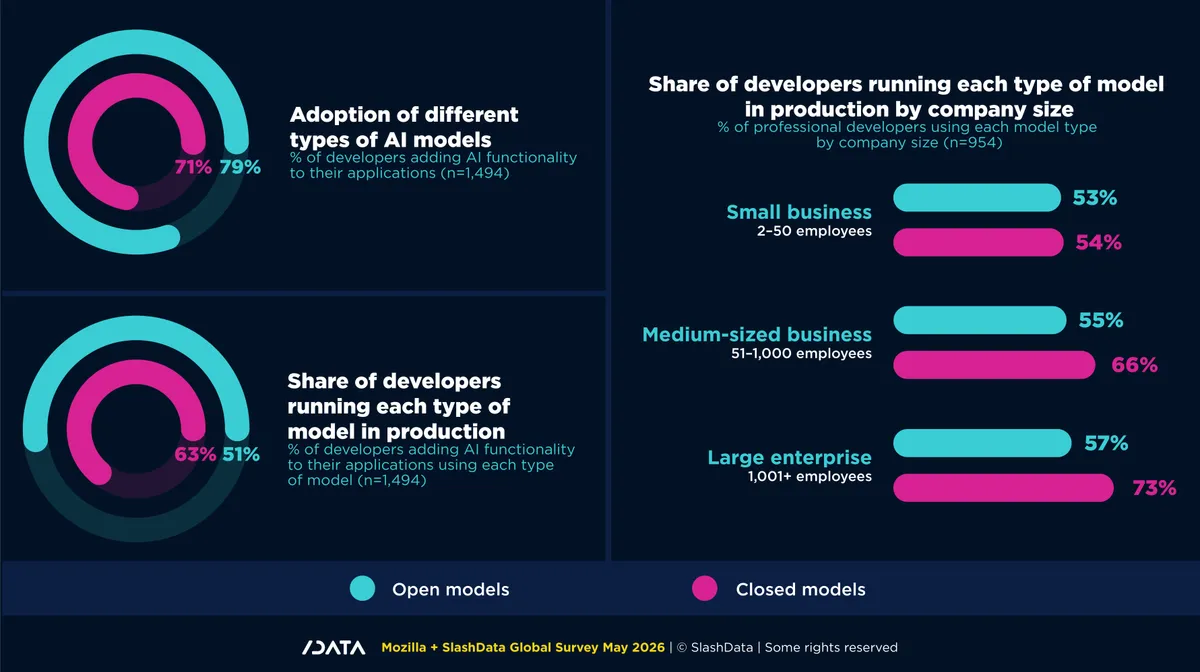
- 79% of developers adding AI functionality to their applications use open models, ahead of 71% for closed models.
- The two are largely complementary. Half of developers use both at the same time, while 29% use only open models, and 21% use only closed models.
- The production gap: only 51% of developers using open models run them in production, compared with 63% for closed models.
- Production rates for closed models climb steeply with organisation size, from 54% at small businesses to 73% at large enterprises. Rates for open models barely move, from 53% to 57%.
What developers using open models actually struggle with: deployment, scaling, maintenance
Among developers adding AI functionality to their applications, more use open models today than closed ones, 79% against 71%. However, open models lag in production. Only 51% of developers using open models run them in production, compared with 63% for closed models, and open models trail slightly at the pilot stage as well (60% vs 65%). Developers are ready for open models, but the ecosystem around them may not be.
According to the global survey that SlashData and Mozilla ran together in May 2026 (opens in a new tab), covering 1,494 developers adding AI functionality to their applications, open models are the most widely used of the two families. It is important to note, though, that for many developers this is not a choice between one and the other: 50% of developers use both, while 29% use open models only, and 21% use closed models only. Adoption of open models is highest in Greater China and East Asia, at 89% each, against a global average of 79%.
However, production rates for open models (51%) are noticeably lower than for closed models (63%). The data reveals that model performance is not what explains the difference, as it ranks among the least cited challenges for developers using open models. Some of the most common difficulties reported are the complexity of deployment and scaling, ongoing maintenance and updates, and managing the infrastructure and its costs. All of these point to the operational side rather than the models: the burden of owning the stack. That ownership brings real benefits, but it also introduces a set of problems that a hosted API absorbs on the developer's behalf.
Additionally, SlashData found that, among professional developers, production rates for closed models climb steeply with organisation size, from 54% at small businesses (2 to 50 employees) to 73% at large enterprises (1,001 or more). For open models, however, production rates remain relatively flat across organisation sizes (from 53% to 57%).
The next gains sit around the model, not inside it
If the barrier were resources or in-house expertise, large enterprises would show the same lift for open models that they show for closed ones. They do not, which suggests this is not a gap that individual organisations can buy their way out of.
For open model providers, foundations and tooling vendors, that flat line is the finding to act on. The demand side is already there: 79% of developers adding AI functionality to their applications are using open models. The loss happens further down the funnel, between working with a model and running it in production.
The work likely to move production rates for open models sits around the model rather than inside it: the harness, hosting and serving infrastructure, upgrade and versioning paths, and better tooling. These map closely onto what developers using open models report as their main challenges, while model performance ranks among the least cited. Based on the data from this survey, those areas are likely to shift production rates further than additional gains in model quality.
Commission your own research
Need data-backed insights for your next thought leadership report?